

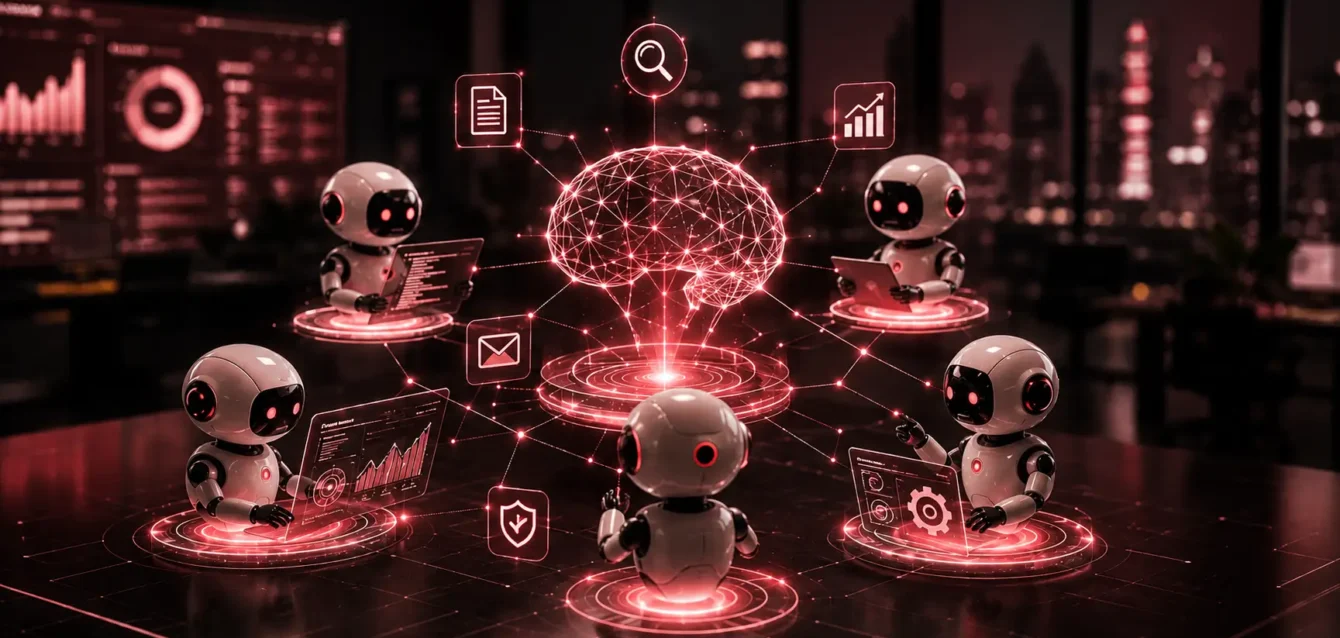
Artificial intelligence is entering a new phase in 2026. Businesses are moving beyond traditional chatbots and standalone AI assistants toward AI agents that can plan, execute tasks, use tools, and collaborate with other agents.
This shift is changing how companies approach automation. Instead of asking an AI chatbot to complete one task at a time, organizations can increasingly deploy multiple specialized AI agents that work together across complex business processes.
According to McKinsey’s 2026 State of AI survey, 40% of respondents from organizations with more than $1 billion in annual revenue report that they are scaling AI agents, compared with 27% the previous year. This highlights how quickly agentic AI is moving from experimentation toward enterprise adoption.
What Is Agentic AI?
Agentic AI refers to AI systems designed to work toward a goal rather than simply respond to a single prompt.
A traditional chatbot generally follows a simple interaction: a user asks a question and the system generates an answer. An AI agent can take a broader approach. Depending on its permissions and design, it can break a goal into smaller tasks, use software tools, retrieve information, make decisions, and take actions with limited human intervention.
For example, instead of asking an AI assistant to create a sales report manually, an agent could retrieve information from a CRM, analyze recent sales activity, identify trends, prepare a report, and send it to the appropriate team.
This makes AI agents particularly valuable for workflows involving multiple steps and systems.
How Do Multi-Agent AI Systems Work?
A multi-agent AI system divides a complex workflow among multiple specialized agents.
Rather than expecting one AI system to handle everything, organizations can assign different responsibilities to different agents.
For example, a business process might include:
- A research agent that gathers relevant information
- An analysis agent that evaluates the information
- A planning agent that determines the next steps
- An execution agent that interacts with business software
- A review agent that checks the result
An orchestration layer can coordinate these agents, determine which agent should act next, and pass information between them.
Microsoft describes multi-agent systems as an approach where responsibilities are divided across specialized agents, providing greater modularity and separation of concerns while also introducing additional coordination and orchestration requirements.
The result is closer to an AI-powered digital team than a traditional chatbot.
How AI Agents Collaborate
The real potential of agentic AI comes from collaboration.
Imagine an e-commerce company wants to investigate declining sales. Instead of assigning the entire task to one AI system, several agents could work together.
One agent could analyze sales data, another could research customer feedback, another could review marketing campaigns, and another could identify potential causes. A coordinating agent could then combine their findings into a recommendation for the management team.
This type of collaboration can make complex workflows more modular and scalable.
McKinsey notes that AI agents are increasingly capable of operating within an “agentic mesh,” where agents coordinate with other agents, tools, and transactional systems across an organization.
Practical Business Use Cases for AI Agents
The applications of AI agents extend across almost every business function.
Customer Support
AI agents can classify incoming requests, retrieve customer information, identify potential solutions, and route complex cases to human representatives.
This can help support teams handle larger volumes while allowing employees to focus on issues that require judgment or personal interaction.
Sales and Marketing
Sales agents can help research prospects, summarize customer interactions, prepare outreach materials, and update CRM information.
Marketing agents can analyze campaign performance, research audiences, generate reports, and identify opportunities for optimization.
Software Development
Coding agents are becoming another important enterprise use case. McKinsey reports that around two in ten organizations are already scaling software coding agents, with adoption higher among large enterprises.
Multiple agents can potentially support different stages of development, including research, coding, testing, documentation, and review.
Business Operations
Agents can connect different systems and automate repetitive workflows involving documents, data, approvals, reporting, and internal processes.
This creates opportunities for businesses to automate processes that previously required employees to move information manually between multiple applications.
Human + AI Collaboration
The growth of AI agents does not mean humans become irrelevant.
Instead, the role of employees can shift from performing every individual step to setting objectives, defining rules, reviewing results, and making important decisions.
For example, an AI agent might analyze thousands of records and prepare a recommendation, while a human manager makes the final decision.
This human-in-the-loop approach is particularly important for high-impact workflows where accuracy, accountability, or business judgment matters.
Why Enterprise Adoption Is Growing in 2026
Several factors are driving the adoption of AI agents.
First, AI models have become increasingly capable of reasoning across multiple steps. Second, businesses now have more mature cloud platforms, APIs, data systems, and automation tools that allow AI to interact with existing software.
Organizations are also moving from isolated AI experiments toward broader workflow integration.
Microsoft’s 2026 guidance emphasizes that scaling agentic AI requires more than deploying technology. Businesses also need operating models, governance, risk controls, monitoring, and clear ownership for their agents.
Challenges Businesses Need to Consider
Despite the potential, multi-agent AI introduces new challenges.
Security is one of the biggest concerns because agents may have access to business data and software systems.
Reliability is another challenge. An error made early in a multi-step workflow can potentially affect subsequent actions.
Governance also becomes more complicated as organizations deploy larger numbers of agents. Businesses need to know which agents exist, what data they can access, what actions they can perform, and who is responsible for them.
Agent sprawl can become a significant problem if teams create agents independently without centralized oversight. Enterprise AI therefore requires appropriate identity, permissions, monitoring, and lifecycle management.
The Future of Multi-Agent AI
The evolution from chatbots to AI agents represents a fundamental change in how businesses use artificial intelligence.
The next stage is not simply about creating smarter individual assistants. It is about building connected AI systems capable of coordinating work across departments, applications, and business processes.
Organizations that approach this transition strategically can use AI agents to improve productivity, automate complex workflows, and help employees focus on higher-value work.
However, successful adoption will require more than choosing an AI model. Businesses will need reliable infrastructure, well-designed workflows, strong security, human oversight, and responsible governance.
Conclusion
AI agents are becoming one of the defining developments in enterprise technology in 2026. As businesses move from individual chatbots toward multi-agent systems, AI is evolving from a tool that answers questions into technology that can participate in entire workflows.
The companies that benefit most will not necessarily be those that deploy the largest number of agents. They will be the ones that identify the right processes, connect AI to their existing systems, and create a balanced approach where AI handles execution while people provide direction, judgment, and accountability.
The future of business AI is increasingly collaborative, and multi-agent systems are helping build that future.