

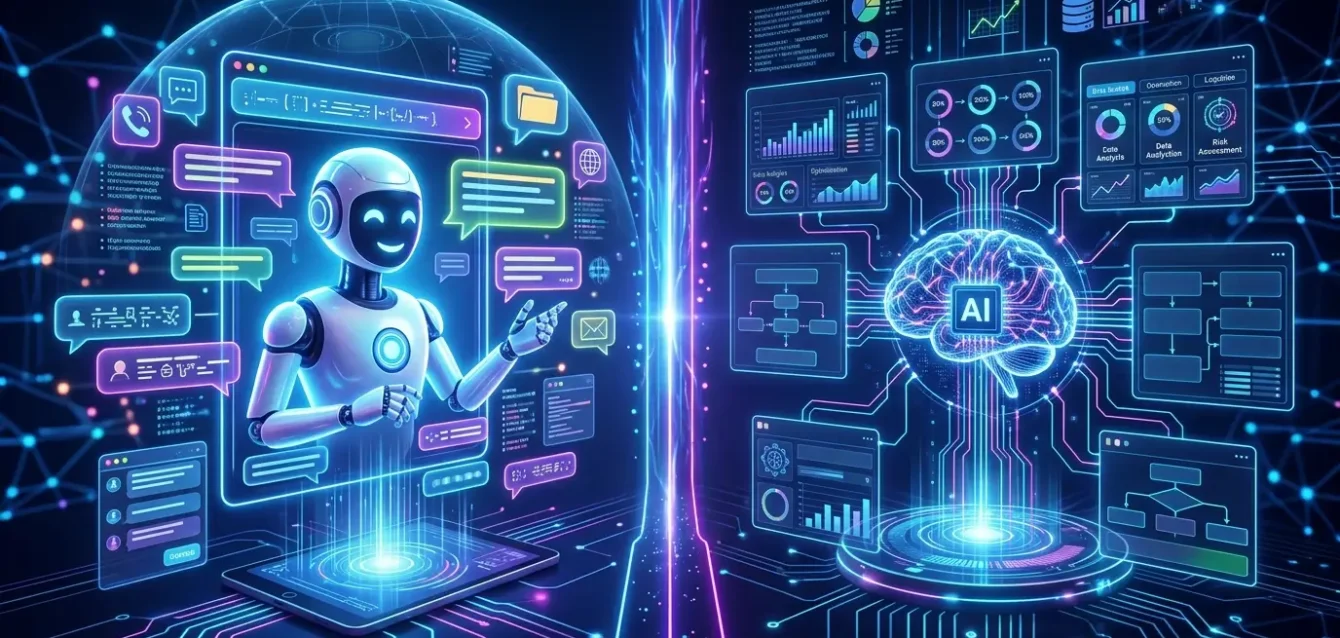
Artificial Intelligence is growing faster than ever before. Every year, we see new AI tools that can write content, answer questions, automate tasks, and help businesses work more efficiently. Two technologies that people often hear about are AI agents and chatbots. Many people think they are exactly the same thing because both can communicate with humans. However, AI agents and chatbots are designed for different purposes. Chatbots are mainly built for conversations, while AI agents are designed to understand goals, make decisions, and complete tasks.
Understanding the difference between these technologies helps us see where the future of artificial intelligence is heading.
What Is a Chatbot?
A chatbot is a computer program that communicates with users through text or voice messages. The main purpose of a chatbot is conversation. When you ask a question, the chatbot understands your message and provides a response.
Businesses commonly use chatbots for:
- Customer support
- Answering common questions
- Product information
- Booking systems
- Online assistance
For example:
A customer visits an online store and asks:
“Where is my order?”
The chatbot checks the information and gives the customer an update. This makes customer service faster and easier.
How Do Chatbots Work?
Traditional chatbots follow predefined rules. Developers create possible questions and answers. When users ask something, the chatbot searches for the closest matching response. Modern AI chatbots are much smarter. They use artificial intelligence and natural language processing to understand human conversations.
AI chatbots can:
- Understand different writing styles
- Generate natural responses
- Remember conversation context
- Provide better answers
This makes conversations feel more human.
What Is an AI Agent?
An AI agent is a more advanced artificial intelligence system that can understand a goal and take actions to complete it. Instead of only answering questions, AI agents can plan, make decisions, and perform multiple steps. Think of a chatbot as someone who answers your questions. Think of an AI agent as someone who helps you complete the entire task.
For example:
You tell an AI agent:
“Help me prepare a marketing campaign.”
The AI agent may:
- Research ideas
- Create content
- Organize a schedule
- Analyze results
- Suggest improvements
It does more than just reply.
How Do AI Agents Work?
AI agents usually work through a process of understanding, planning, and action.
First, they understand the user’s goal.
Then they decide what steps are needed.
Finally, they complete those steps using available tools and information.
Advanced AI agents can connect with different systems such as:
- Websites
- Databases
- Business tools
- Software applications
This ability makes them useful for automation.
Main Differences Between AI Agents and Chatbots
Although both technologies use artificial intelligence, they have important differences.
Purpose
Chatbots: Designed mainly for communication.
AI Agents: Designed for completing goals and tasks.
Decision Making
Chatbots: Usually respond based on user input.
AI Agents: Can analyze situations and decide the next action.
Automation Level
Chatbots: Handle simple automation.
AI Agents: Can manage complex workflows.
Flexibility
Chatbots: Usually work within limited areas.
AI Agents: Can adapt to different tasks and situations.
Real-Life Examples of Chatbots
Chatbots are already common in everyday technology.
Examples include:
Customer Service Bots: Helping users solve common problems.
Shopping Assistants: Recommending products and answering questions.
Website Support Bots: Guiding visitors and collecting information.
Chatbots are especially useful when fast communication is needed.
Real-Life Examples of AI Agents
AI agents are becoming popular because they can handle more advanced work.
Examples include:
Business AI Agents: Managing reports, emails, and workflows.
Coding AI Agents: Helping developers write and improve software.
Research Agents: Finding information and organizing knowledge.
Productivity Agents: Helping users manage daily activities.
Are AI Agents Better Than Chatbots?
The answer depends on the purpose. A chatbot is better when the goal is simple communication.
For example:
A company that needs basic customer support may only need a chatbot. An AI agent is better when the goal requires planning and completing multiple actions.
For example:
A company that wants to automate business operations may need AI agents. Both technologies have important uses.
Will AI Agents Replace Chatbots?
AI agents will probably become more common in the future, but chatbots will not disappear. Instead, many chatbots may become smarter by adding AI agent features.
Future digital assistants may combine:
- Natural conversations
- Decision making
- Automation
- Personal assistance
This combination will create more powerful AI systems.
The Future of AI Assistants
The future of artificial intelligence is moving toward more independent and helpful systems.
AI assistants may help people:
- Manage businesses
- Learn new skills
- Complete projects
- Organize information
- Improve productivity
AI agents and chatbots are both important steps toward this future.
Final Thoughts
AI agents and chatbots may look similar, but they are built for different purposes. Chatbots focus on conversations and quick responses. AI agents focus on understanding goals and completing tasks. As artificial intelligence continues to improve, these technologies will become smarter and more useful. The future is not only about talking with AI — it is about working together with intelligent digital assistants.