

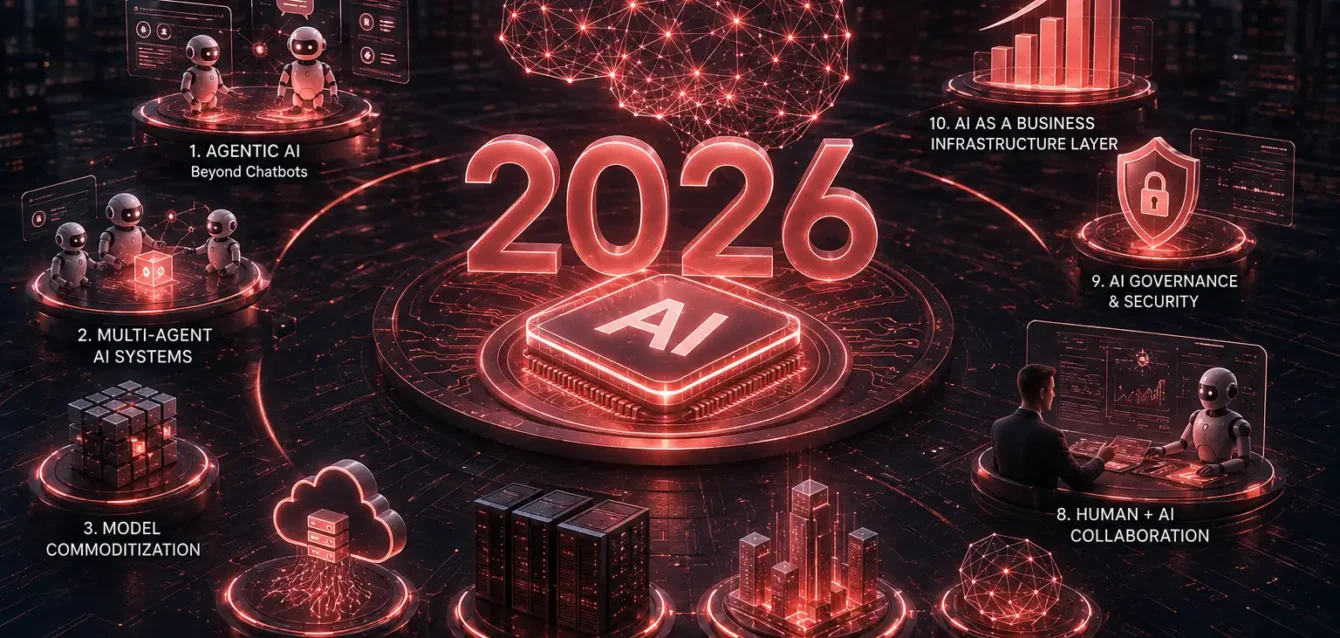
Artificial intelligence is moving into a new phase in 2026. The conversation is no longer limited to larger language models or smarter chatbots. AI is becoming more deeply connected to business workflows, software, infrastructure, customer experiences, and decision-making.
Organizations are now exploring AI agents, multi-agent systems, AI-native applications, specialized infrastructure, open-weight models, and new approaches to AI governance.
According to McKinsey’s 2026 State of AI research, AI adoption continues to expand, while organizations are increasingly experimenting with and scaling AI agents. At organizations with annual revenues above $1 billion, 40% of respondents report scaling AI agents, compared with 27% the previous year.
Here are 10 AI trends that businesses should watch closely in 2026.
1. Agentic AI Is Moving Beyond Chatbots
One of the biggest AI trends in 2026 is the shift from conversational assistants toward agentic AI.
Traditional chatbots primarily respond to user prompts. AI agents can be designed to pursue goals, plan multiple steps, use tools, retrieve information, and execute actions.
For businesses, this means AI can become part of an actual workflow rather than simply being a tool employees use occasionally.
For example, an AI sales agent could research a prospect, analyze CRM information, prepare an outreach draft, and update relevant records.
The focus is shifting from generating answers to completing tasks.
2. Multi-Agent AI Systems Are Emerging
A single AI agent does not always need to handle an entire workflow.
In multi-agent systems, different AI agents can specialize in different responsibilities. One agent might conduct research, another analyzes information, another plans the workflow, and another executes approved actions.
An orchestration layer coordinates the process.
This approach can make complex AI workflows more modular and allow businesses to build specialized digital teams.
McKinsey’s 2026 research highlights the growing importance of agentic systems and the movement toward more coordinated AI environments.
3. AI Models Are Becoming More Commoditized
The AI model market is becoming increasingly competitive.
Businesses now have access to a growing range of proprietary and open-weight models. As performance differences narrow for many common tasks, simply having access to a particular model may become less of a competitive advantage.
The important questions increasingly become:
- Which model is right for the task?
- What does it cost?
- How fast can it respond?
- Where can it be deployed?
- How secure is the deployment?
- Can it scale?
This creates opportunities for companies to build competitive advantage through data, workflows, infrastructure, and implementation, rather than relying only on model selection.
4. AI Inference Is Becoming a Major Priority
Training AI models receives a lot of attention, but businesses ultimately need to run those models.
Every AI interaction requires inference—the computing process that generates an output.
As AI becomes embedded in customer service, search, analytics, coding, business applications, and autonomous workflows, inference demand is increasing rapidly.
Deloitte expects inference workloads to represent approximately two-thirds of AI compute in 2026, highlighting how important inference efficiency is becoming.
For businesses, optimizing inference can directly influence AI costs, response times, and scalability.
5. AI Infrastructure Is Becoming a Strategic Advantage
AI requires more than software.
Organizations need computing power, accelerators, networking, memory, storage, data centers, cooling, and energy.
As AI workloads grow, infrastructure is becoming an increasingly important part of corporate AI strategy.
Companies are therefore evaluating whether particular workloads should run in public cloud environments, private infrastructure, on-premises systems, or hybrid architectures.
The goal is no longer simply to access AI.
It is to run AI efficiently at scale.
6. AI-Native Businesses Are Emerging
Another major trend is the rise of AI-native businesses.
These companies are not simply adding AI to existing products. AI is becoming part of their core architecture and value proposition from the beginning.
An AI-native business may use AI throughout:
- Product development
- Customer service
- Sales
- Marketing
- Operations
- Data analysis
- Software development
This can allow smaller teams to build and operate products that previously required significantly larger organizations.
For established businesses, the challenge is determining whether they should simply add AI features or rethink entire workflows around AI.
7. Open-Weight Models Are Expanding Options
Open-weight models are becoming increasingly important in enterprise AI.
They can give organizations greater flexibility around deployment, customization, and infrastructure choices, depending on the model’s licensing terms.
They can also provide an alternative to relying exclusively on managed closed-model APIs.
However, open-weight does not automatically mean better. Businesses still need to evaluate performance, security, maintenance requirements, infrastructure costs, licensing, and technical expertise.
The broader trend is clear: companies now have more choices in how and where they deploy AI.
8. Human + AI Collaboration Is Becoming the New Operating Model
AI is not simply about automation.
In many businesses, the most valuable applications will combine machine capabilities with human expertise.
AI can process large amounts of information, identify patterns, generate drafts, and perform repetitive work. Humans can provide context, creativity, judgment, accountability, and strategic direction.
This creates a model where employees increasingly work with AI systems rather than simply using AI tools.
For example, an analyst might use AI to process thousands of records and identify trends, then use their expertise to determine what those findings mean for the business.
9. AI Governance and Security Are Becoming Essential
As AI becomes more autonomous, governance becomes increasingly important.
An AI system that only generates text presents one type of risk. An AI agent that can access databases, send messages, modify records, or trigger business processes presents a much larger one.
Organizations therefore need clear controls around:
- Data access
- Identity and permissions
- Agent actions
- Monitoring
- Human approval
- Security
- Compliance
- Accountability
Enterprise AI needs to be designed with governance from the beginning rather than adding controls after deployment.
This is especially important as regulatory requirements around AI continue to develop globally.
10. AI Is Becoming a Business Infrastructure Layer
Perhaps the biggest trend is that AI is becoming less of a standalone technology and more of a business infrastructure layer.
AI is increasingly being integrated into existing applications, workflows, data platforms, customer experiences, and internal systems.
This means successful AI adoption will require collaboration between business leaders, technology teams, security professionals, data specialists, and employees.
The future enterprise may not have a single “AI department.” Instead, AI capabilities could become embedded across nearly every part of the organization.
What These AI Trends Mean for Businesses
These trends point toward an important change in business strategy.
Companies should not approach AI simply by asking:
“Which AI tool should we buy?”
A better question is:
“How can AI fundamentally improve the way we operate?”
Businesses should identify processes where AI can create measurable value, evaluate the appropriate models and infrastructure, establish security and governance controls, and prepare employees to work effectively with AI.
The organizations that move fastest will not necessarily be the ones using the most AI.
They will be the ones using it strategically.
The Future of AI in 2026 and Beyond
The AI landscape is moving rapidly from experimentation toward integration.
Agentic AI is making systems more capable of completing tasks. Multi-agent architectures are enabling collaboration between specialized systems. AI infrastructure is expanding to support growing inference demand, while open-weight models are giving businesses more deployment choices.
At the same time, AI-native businesses are demonstrating new ways of building products and operating organizations.
Together, these developments suggest that the next phase of AI will not be defined by chatbots alone.
It will be defined by AI-powered workflows, intelligent infrastructure, autonomous agents, and organizations designed to combine human expertise with machine intelligence.
Conclusion
2026 is becoming a defining year for enterprise AI.
The most important developments are not isolated technologies. They are connected trends that are changing how businesses build, deploy, and use artificial intelligence.
From agentic AI and multi-agent systems to AI infrastructure, open-weight models, AI-native businesses, and enterprise governance, the technology is becoming increasingly integrated into the way organizations operate.
Businesses that focus on practical use cases, secure deployment, efficient infrastructure, and human-AI collaboration will be better positioned to turn AI capabilities into sustainable business value.
The next AI revolution is not just about smarter models. It’s about building smarter businesses around them.